

30 Seconds Summary
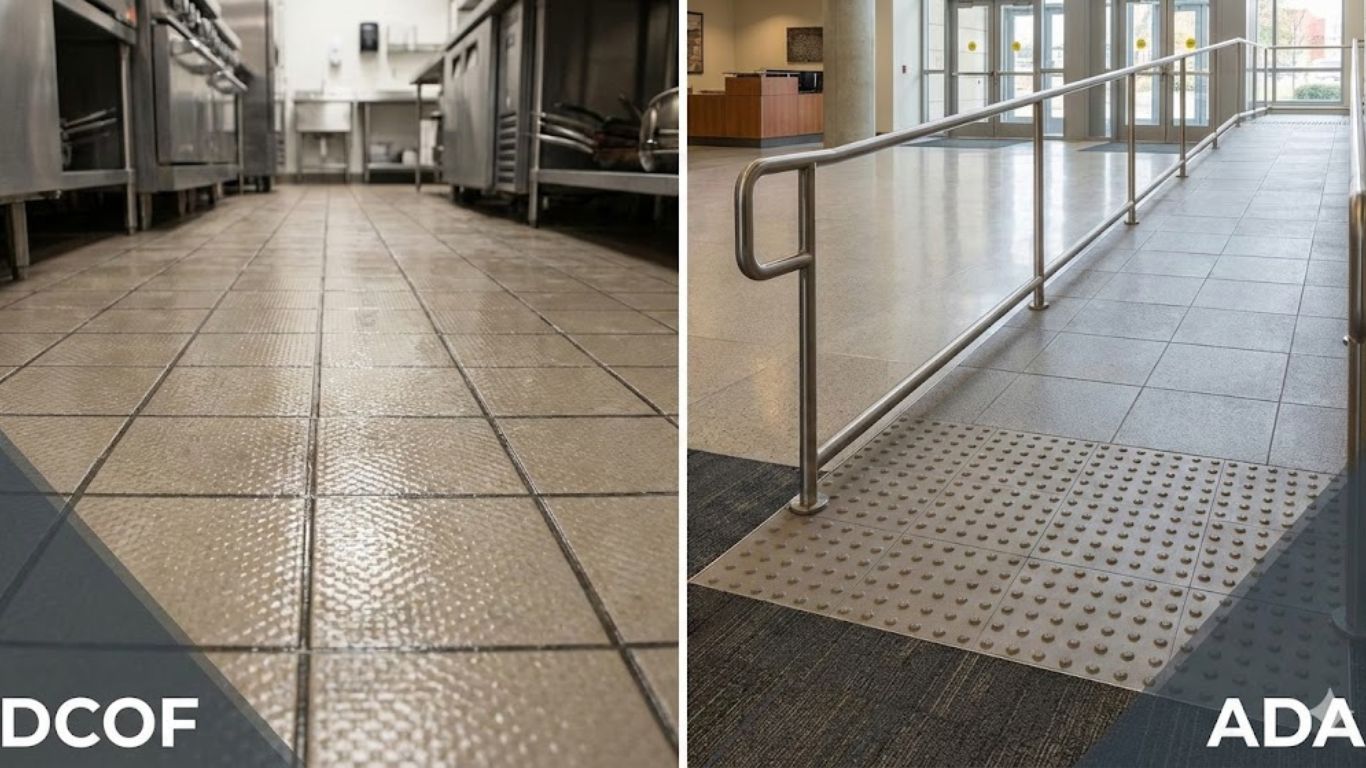
- DCOF is the modern standard for slip resistance, replacing SCOF, and measures traction while walking, not just standing.
- Level interior floors should have a DCOF > 0.42; wet areas such as showers or pool decks require higher values (≈0.60) for safety.
- Tile texture, size, and drainage are as important as DCOF. Smaller tiles and unglazed finishes give better grip.
- Following DCOF ADA Compliance makes floors safer for everyone and helps avoid accidents or legal issues in public and commercial buildings.
Slip and fall accidents are a serious concern in public and commercial buildings. They can lead to injuries, lawsuits, and long-term costs that no project team wants to deal with. For architects, designers, specifiers, and property owners, flooring decisions play a direct role in avoiding slip and fall liability and supporting better risk management from the start.
Tile is often chosen because it lasts a long time and looks good, but when choosing a tile, you need to think about how it will perform in wet and high-traffic areas as well. To make sure that the tile is safe for use, professionals usually rely on the Dynamic Coefficient of Friction (DCOF), ADA Compliance guidelines, and the ANSI A326.3 standard. Together, these standards explain how tile behaves when people walk on it, especially in wet or high-traffic areas.
In this guide, we are going to explain DCOF Compliance for title safety and how DCOF ADA Compliance works together. So you, as a professional, can choose a tile that meets safety requirements, supports accessibility, and reduces long-term risk.
Shop safe and reliable tile options at Mosaicenter.
Key Compliance Factors at a Glance
|
What is DCOF? Understanding the ANSI A326.3 Standard
The Dynamic Coefficient of Friction (DCOF) measures how slippery a floor is while walking. Unlike its predecessor, scof (Static Coefficient of Friction), which only measured slip risk when standing still, DCOF shows how a surface behaves in real life, including wet conditions and normal walking. This makes it the best standard for risk management in public spaces and commercial buildings.
The ANSI A326.3 standard explains how DCOF should be tested. Using a small water solution and the BOT-3000E, it simulates a person walking to give accurate, repeatable results. This helps professionals select slip-resistant tile with confidence.
For floors that may get wet, such as lobbies, restaurants, hospitals, and commercial kitchens, ANSI A137.1 requires a minimum dcof of> 0.42. Tiles that meet this number are safer and support ADA Compliance.
For high-risk areas such as showers, pool decks, or exterior walkways, tiles should have a higher DCOF to prevent accidents. Similarly, exterior tile slip resistance is important for outdoor walkways, patios, and entrances where moisture is common. Even the finish of a tile, i.e., polished vs honed tile, can affect safety. Polished tiles are smoother and may be more slippery, while honed tiles have better grip.
Professionals should use ANSI A326.3 and proper dcof testing methods to choose durable, safe, and compliant flooring that reduces liability and slip-and-fall risks.
DCOF vs. SCOF: Why the Old Standard is Obsolete

In the past, the Static Coefficient of Friction (SCOF) was used to measure how safe a floor was. It checked how much force it took to start moving a stationary object. But this doesn’t match real life. People usually slip while walking, not while standing still. That’s why SCOF often gave misleading results, especially on wet floors or polished surfaces.
Today, the Dynamic Coefficient of Friction (DCOF) is the standard for measuring tile safety. It tests how much friction a floor provides while someone is already moving. This makes it much closer to real conditions, including wet conditions and normal walking. The ANSI A326.3 standard guides this test, using the BOT-3000E device and a controlled water solution to simulate walking.
Here is a simple comparison of the two, showing why the old standard became obsolete:
|
Feature |
SCOF (Old Standard) |
DCOF (Modern Standard) |
|
What it measures |
Force needed to start motion while standing still |
Force needed to keep moving while walking |
|
Relevance to slips |
Low: People don’t usually slip when standing |
High: reflects real walking slips |
|
Current status |
Obsolete (ASTM C1028 withdrawn) |
Active standard (ANSI A137.1 & ANSI A326.3) |
|
Wet testing |
Used dry or de-ionized water, making results unreliable |
Uses slightly soapy water, providing realistic results |
Specifying for Safety: DCOF Requirements in Practice

When you are choosing a tile for your project, you don't just have to think of its appearance; you need to consider safety as well. The Dynamic Coefficient of Friction (DCOF) tells you how slippery a floor really is when people walk on it, especially if it’s wet. The ANSI A326.3 standard makes sure this is tested the right way. By following these guidelines, architects, designers, and property owners can reduce the risk of liability and create safer environments in public spaces and commercial buildings.
The Magic Number: DCOF > 0.42 for Level Interior Spaces
For most indoor areas that may get wet, like lobbies, corridors, and restrooms, a DCOF rating of 0.42 or higher is considered the standard. This meets the ANSI A137.1 and A326.3 standards for wet areas.
A DCOF of 0.42 or higher does not mean that the floor is absolutely slip-resistant; however, it helps professionals choose tiles that are safer for everyday use. Traffic, cleaning, and the choice of footwear can still affect safety, but meeting this threshold is one of the first reliable steps for slip-resistant tile in public and commercial spaces.
Check out ceramic tile from Mosaicenter that meets DCOF compliance for tile safety.
DCOF Requirements for Shower Floors & Wet Areas
Shower floors, pool decks, and other wet areas are high-risk because water is always present. For these spaces, the DCOF for shower floors should be higher than the standard 0.42, usually around 0.60, to reduce the chances of slips and falls.
Tile texture and size are just as important as the DCOF number. Smaller tiles and mosaics with more grout lines provide extra grip and help in water drainage as well. Smooth and polished tiles can trap water and make the floor slippery. This is why you should compare polished vs. honed tiles DCOF whenchoosing tiles for wet area flooring.
Drainage is just as important. Floors should slope toward drains so water doesn’t pool, because even a slip-resistant tile can be dangerous if water collects.
Meeting ADA requirements for bathroom floors is also necessary. ADA-compliant tiles make the floor stable and easy to use for everyone, including people who use mobility aids.
Have a look at the porcelain tile options at Mosaicenter that meet high DCOF standards for wet areas.
Exterior Tile and Transitional Spaces (Entrances)
Entrance areas, walkways, and other transitional spaces face extra challenges because they are exposed to the weather and heavy foot traffic. Rain, snow, ice, and even dirt tracked in from outside can make these surfaces very slippery. That’s why exterior tile slip resistance needs to be higher than interior floors. For most outdoor or transitional areas, a wet DCOF of 0.60 or higher is recommended.
These areas get a lot of foot traffic, and people come in wearing all kinds of shoes, boots, sneakers, or heels, often tracking in water, mud, or snow. Even tiles that feel safe when dry can become slippery when wet or dirty. That is why using a slip-resistant tile with a textured or unglazed surface will provide better grip and prevent accidents.
Check out tile sizes available at Mosaicenter and choose a strong, slip-resistant tile perfect for entrances, patios, and outdoor areas.
FAQs
Q: What is an acceptable DCOF rating?
A: An acceptable DCOF rating depends on where the tile will be used. For most indoor floors that may get wet, like lobbies, restrooms, or corridors, a DCOF > 0.42 is considered safe. For wet areas like showers or pool decks, a higher DCOF of around 0.60 or more is recommended. Outdoor tiles or entrances also need higher slip resistance because of rain, snow, or mud.
Q: What is the difference between DCOF and SCOF?
A:DCOF (Dynamic Coefficient of Friction) measures how much grip a floor provides while someone is walking. SCOF (Static Coefficient of Friction) only measures slip risk when standing still. People usually slip while moving, not standing, so SCOF often gave misleading results. Today, DCOF is the accepted standard, guided by ANSI A326.3, and is much more reliable for wet and high-traffic areas.
Q: Is polished porcelain tile ADA compliant?
A: Polished porcelain tiles are smooth, so they may be slippery when wet. For areas that need ADA Compliance, such as bathrooms, ramps, or entrances, it’s better to use ADA-compliant tile with a higher DCOF or a textured finish. This makes sure that the floor is safe and easy to use for people with mobility aids.
Q: How is DCOF measured?
A: DCOF is measured using the ANSI A326.3 test, which is designed to simulate real walking conditions. The test uses a device called the BOT-3000E, along with a small quantity of water solution, to mimic wet surfaces. A rubber sensor slides across the tile, measuring how much friction it has while moving. This gives a reliable number that tells designers and specifiers how slip-resistant a tile is in wet conditions.
Q: Does the ADA require a specific DCOF?
A: The ADA does not give a fixed number for DCOF. Instead, it focuses on floor surfaces being safe, stable, and easy to use, especially for people using wheelchairs or other mobility aids.
Over to You
When picking a tile for your project, don’t just think about its appearance, but consider its safety, accessibility, and long-term reliability. By following DCOF Compliance for tile safety and DCOF ADA Compliance guidelines, professionals can choose floors that reduce slip risk, meet accessibility standards, and lower liability in public and commercial spaces.
For safer, durable, and compliant flooring options, visit Mosaicenter today.
Find the right tile for your project at Mosaicenter.

Halil I Oguz
Founder & Tile Expert
Halil I Oguz is the founder of Mosaicenter, the natural stone and porcelain tile supplier he launched in 2018 and now runs across the United States and Canada.
He leads the company's product selection and writes its technical library, covering DCOF slip ratings and ADA compliance, TCNA installation standards, and the selection and care of natural stone.
His work as a founder has been featured in Authority Magazine. Read full bio →


Leave a comment
This site is protected by hCaptcha and the hCaptcha Privacy Policy and Terms of Service apply.